CRW to New River Gorge: A Group Transportation Planning GuideHow to turn an airport arrival, a mountain destination and several travelers into one workable West Virginia itinerary
A New River Gorge trip often begins with a simple request—pick up the group at West Virginia International Yeager Airport and take everyone to the park. The difficult part is that “the park” is not one curb. Visitor centers, overlooks, lodging, outfitters and gateway communities are spread across a long mountain corridor.
This guide shows trip leaders how to plan the ground portion from CRW without guessing at pickup timing, road access or vehicle space. It focuses on the decisions that matter before a quote: the exact first stop, every traveler and bag, the activity schedule, communication in low-signal areas and the return journey.
The practical answer
Use the flight number and local arrival date for CRW, then name a precise road-accessible destination such as a hotel, outfitter, lodge or National Park Service visitor center. Build one manifest for the group, count luggage and outdoor equipment, check current road and park alerts, and reserve the return as its own leg. A park name alone is not enough for dispatch.
- Closest major airport listed by NPS
- Charleston, West Virginia—served by CRW—is about 70 miles northwest of the park.
- The park is not one address
- Canyon Rim, Grandview, Sandstone and Thurmond have different approaches and meeting points.
- Mountain-road timing needs room
- NPS notes that many park roads are narrow and winding, so schedules should include extra time.
First, Replace “New River Gorge” with One Exact First Stop
New River Gorge National Park and Preserve extends across multiple communities and access points. The first planning task is to decide where the vehicle is actually going after the airport—not which attraction name appears in the group chat.
- • For a visitor-center start, use the National Park Service physical address for the specific center rather than a map pin saved from a third-party app.
- • For lodging, send the property name, complete street address, check-in entrance and a working front-desk number.
- • For a rafting, climbing or guided outing, use the operator’s check-in address and required arrival time; park admission and guided activities are separate from transportation.
- • For a vacation rental, confirm that the host’s directions identify a road-accessible passenger drop-off and not only a mailing address.
- • If the first evening is in Charleston, list that hotel stop separately from the following day’s journey to the gorge.
- West Virginia service area
- New River Gorge transportation guide
- Charleston riverfront transportation guide
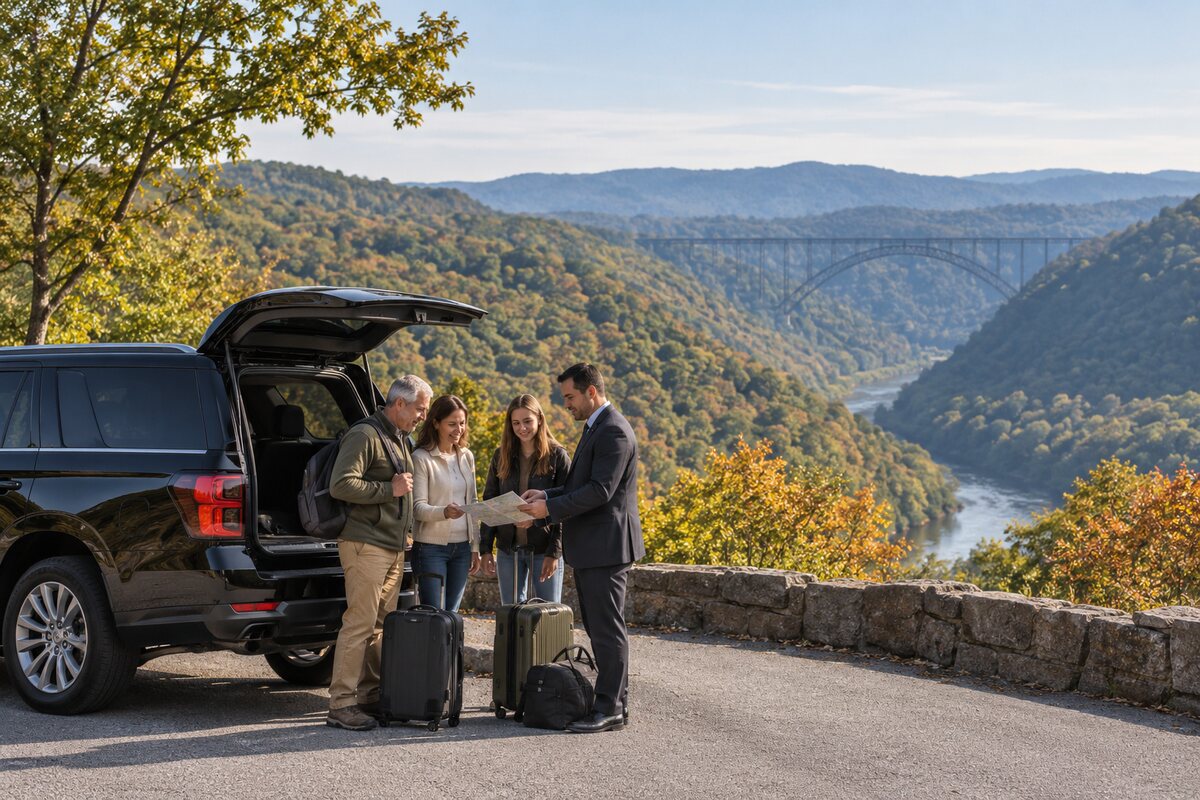
The National Park Service warns that third-party mapping apps can send visitors to rough or inaccessible terrain instead of a visitor center. Its current directions page publishes physical addresses and coordinates for Canyon Rim, Sandstone, Grandview and Thurmond. Use the address that matches the planned stop, then confirm the passenger meeting point. Cover image: generated editorial artwork representing West Virginia trip planning; it is not a photograph of a Genius Limo vehicle, chauffeur or park pickup.
Treat CRW Arrival as a Handoff, Not a Landing-Time Promise
West Virginia International Yeager Airport uses the code CRW. Put that code, the operating airline and the flight number on the reservation so the airport is not confused with another Charleston. The scheduled landing time starts the arrival process; it is not automatically the moment the whole group is ready to load.
Name one airport lead
Choose one traveler who can confirm when everyone is off the aircraft, has collected bags and is moving to the agreed public meeting point.
Make the traveler list visible
Provide each passenger’s name and mobile number, plus the trip planner’s backup contact. A flight status cannot show that someone is still at baggage claim.
Confirm the pickup instruction
Use the meeting location provided for the reservation and follow current airport signs and staff directions. Do not assume that a taxi, shuttle or private-vehicle area applies to every service type.
CRW’s official airport site provides live flight information, directions and a Hotels & Transportation section. Recheck the flight and airport instructions close to travel. If the group changes flights, send the revised itinerary rather than expecting the original reservation to follow a different flight automatically.
Build One Manifest Before Choosing a Vehicle
The vehicle decision should follow the passenger and equipment count. A group of six with only overnight bags is a different assignment from six travelers bringing large suitcases, coolers, climbing gear or mobility equipment.
- • List every passenger, including children, and request child seats before booking when needed.
- • Count checked bags, carry-ons and personal items separately; describe oversized pieces and outdoor equipment.
- • Note mobility devices and any assistance requirements so suitability can be evaluated in advance.
- • If travelers arrive on more than one flight, state who will wait for whom and when a separate transfer should be considered.
- • Ask the reservations team to confirm the seating and usable cargo space of the proposed vehicle category in writing.
Do not use the advertised passenger maximum as a luggage guarantee. A complete statement such as “seven adults, seven checked bags, four cabin bags and two equipment cases” gives the provider enough information to evaluate the request.
Choose Point-to-Point or Hourly Service by the Day’s Shape
A defined airport-to-lodge transfer and a day connecting overlooks, an outfitter, lunch and a hotel are different transportation plans. Describe the actual itinerary before deciding how the ride should be structured.
Point-to-point transfer
This can fit one confirmed pickup and one road-accessible destination. A grocery stop, meal stop or second lodge is an additional stop and should be included before the quote is finalized.
Hourly or as-directed plan
This may suit a multi-stop day when a vehicle is expected to remain assigned. Provide every known stop, the order, activity start and finish times, and the requested service window. Hourly service does not create access to closed, restricted or non-road areas.
For an outdoor activity, ask the operator where passengers must check in and where the vehicle can legally meet them afterward. The pickup after a rafting or hiking activity may be different from the morning drop-off, and the chauffeur should not be expected to wait in an unauthorized location.
Mountain Roads Change the Schedule—and the Communication Plan
The park’s official basic information says it stretches for 53 miles, that a good map is essential, and that many roads are narrow and winding. That makes route detail, daylight, weather and communication more important than a best-case drive-time estimate.
Check the route, not only the forecast
Review current park road and trail alerts, weather, and West Virginia road conditions close to departure. If conditions change, confirm any revised meeting point with the transportation provider.
Download the details
Save the hotel, outfitter and visitor-center addresses plus phone numbers before leaving the airport. Cellular service can vary; a saved screenshot should support—not replace—the current official instructions.
Avoid a chain of tight reservations
Do not place a tour check-in immediately after an optimistic airport arrival estimate. Allow for flight changes, bags, loading, winding roads and the time required to reach the correct entrance.
NPS directs visitors to check current alerts and closures and notes that Grandview and Thurmond visitor centers are generally seasonal. Confirm current hours with the park or activity operator; a chauffeur reservation does not guarantee that a facility, trail or road is open.
Coordinate Lodging and Activities as Separate Handoffs
A group trip works better when each organization handles the part it controls. The transportation provider confirms the road service. The lodging property confirms check-in and its vehicle entrance. The activity operator confirms tickets, waivers, equipment and check-in.
- • Give the hotel the group’s estimated arrival window and ask which entrance should be used for passengers and luggage.
- • Send the outfitter or event organizer’s exact check-in address and contact number to the transportation team.
- • Do not assume the vehicle can remain at a visitor center, trailhead or private property while the group is away.
- • If the group splits into different activities, create a manifest and transportation plan for each subgroup.
- • Keep tickets, permits, park reservations and activity waivers separate from the transportation confirmation.
When several vendors are involved, one trip leader should hold the final itinerary and distribute only confirmed times and locations. A venue or park name on the reservation does not imply a partnership, special access or permission to enter restricted areas.
Reserve the Return Before the Group Leaves CRW
Remote or time-sensitive pickups are difficult to improvise after an activity. Plan the return to CRW—or the next West Virginia destination—at the same time as the arrival transfer.
- • State the pickup date, exact road-accessible location and passenger-ready time.
- • Include the departure flight number and follow the airline’s current check-in guidance.
- • Allow time to collect stored luggage, return rental equipment, check out and load the vehicle.
- • Choose a backup contact who will remain reachable if the group leader has no signal.
- • If the return location depends on weather or activity operations, agree on the decision deadline and how a change must be confirmed.
A return pickup is not confirmed merely because the arrival ride is booked. Ask for both legs, all stops, the vehicle category, price and applicable waiting, parking, toll, change and cancellation terms in writing.
Send This West Virginia Group Brief with the Quote Request
A concise brief helps reservations evaluate the complete assignment without inventing missing details:
- • Arrival: CRW, operating airline, flight number, local arrival date and scheduled landing time.
- • Group: lead traveler, every passenger, working mobile numbers and the trip planner’s backup contact.
- • Luggage: number and size of bags, plus outdoor, mobility or presentation equipment.
- • First stop: exact road-accessible address, entrance, contact and required arrival time.
- • Itinerary: lodging, visitor center, outfitter, meal, event and other stops in order.
- • Service shape: point-to-point or requested hourly window, subject to availability and confirmation.
- • Return: pickup address, passenger-ready time, CRW flight details and contingency contact.
Send the complete West Virginia itinerary to Genius Limo to request availability and a written quote. Treat the trip as confirmed only after the service details, meeting instructions, vehicle, price and terms are provided in writing.
Frequently Asked Questions
What airport should a New River Gorge group use?
The National Park Service identifies Charleston, West Virginia, about 70 miles northwest of the park, as the closest major airport and notes that some flights are available in Beckley. Compare the actual flights and itinerary, then ask the transportation provider to confirm route coverage from the chosen airport.
Can I book a chauffeur using only “New River Gorge” as the destination?
Use an exact road-accessible address. The park has several visitor centers, overlooks, gateway communities, lodging properties and activity operators. A general park name does not identify the correct entrance or meeting point.
Can one vehicle carry the whole group and its outdoor equipment?
That depends on the passenger count, bag sizes, equipment and the specific vehicle configuration. Send a complete inventory and ask reservations to confirm seating and cargo capacity before accepting the quote.
Should the vehicle wait during rafting, hiking or another activity?
Do not assume it can wait. Share the activity schedule and locations, then ask whether a scheduled return or an hourly assignment is available and where the vehicle may legally stand or return.
How should we handle weak cellular service?
Download the confirmed addresses, contacts and itinerary before leaving the airport, choose a group lead and a backup contact, and agree on a fixed road-accessible return point. Reconfirm changes while a reliable connection is available.
How much is a CRW-to–New River Gorge group transfer?
The price depends on the date, exact route and stops, service duration, vehicle, passengers, luggage and equipment, waiting, parking and other trip-specific terms. Request a written quote for the complete itinerary.
Turn the West Virginia Arrival into One Clear Itinerary
Share the CRW flight, group manifest, luggage and equipment, exact New River Gorge stops, activity times and return plan. Genius Limo can review the request and confirm current availability.
Genius Limo | West Virginia airport, group and destination transportation planning
